Crocodiles, the living relics that have endured the ravages of time for a staggering 65 million years, are an awe-inspiring wonder of nature. Within the enchanting landscape of Sri Lanka, these magnificent reptiles reign supreme, and the island is hailed as one of the premier destinations to witness the majestic Mugger crocodiles, making it an experience like no other in all of Asia.
Crocodiles, those formidable reptiles, dominate the swamps and waterways of tropical Africa, Asia, America, and Australia. Within the Crocodilia family, four prominent groups emerge
- Alligators
- Caimans
- Crocodiles
- Gharials
This article delves into the intriguing world of Sri Lankan crocodiles commonly known as Mugger Crocodiles and Saltwater Crocodiles, revealing their unique characteristics, biology and behavior.
Diversity of Sri Lankan Crocodiles
Crocodiles are a significant part of Sri Lanka’s wildlife and can be found in various parts of the country. There are two species of crocodiles that inhabit Sri Lanka’s waters
- Saltwater Crocodiles
- Mugger Crocodiles
01. Saltwater Crocodile (Crocodylus porosus)
These are the largest living reptiles in the world and are known for their adaptability to both saltwater and freshwater habitats. They are commonly found in estuaries, lagoons, and coastal areas around Sri Lanka. The saltwater crocodile is a formidable predator and is known to be responsible for attacks on humans in some instances. Due to their size and potentially dangerous nature, encounters with saltwater crocodiles should be avoided, and caution is advised when in their habitat.
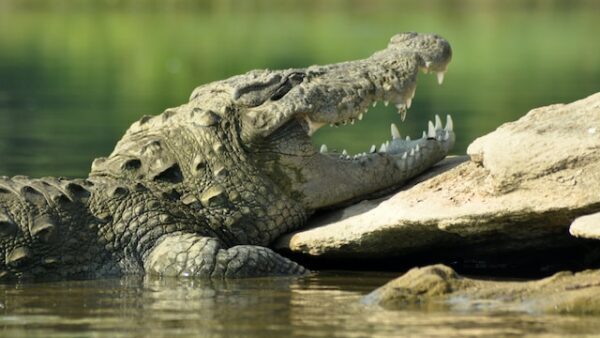
02. Mugger Crocodile (Crocodylus palustris)
Mugger crocodiles are smaller than saltwater crocodiles and are primarily freshwater crocodiles. They inhabit rivers, lakes, and marshes across Sri Lanka. While they are generally less aggressive than saltwater crocodiles, they can still pose a threat to humans if provoked or cornered.
Distinctions between Saltwater Crocodiles and Mugger Crocodiles

Mugger Crocodile

Saltwater Crocodile
In summary, mugger crocodiles and saltwater crocodiles are distinct species with differences in size, habitat preference, behavior, and distribution. Saltwater crocodiles, being the larger and more aggressive of the two, are often considered the more formidable and dangerous species.
Where to see crocodiles in Sri Lanka
Sri Lanka is home to a variety of wildlife, including crocodiles, and you can see them in several places across the country. Here are some popular locations for crocodile sightings in Sri Lanka:
- Yala National Park
- Wilpattu National Park
- Bundala National Park
- Kumana National Park
- Madu Ganga
- Muthurajawela Bird Sanctuary
- Kalpitiya
- Anawilundawa Wetland Sanctuary
When visiting these locations, it’s important to exercise caution and adhere to safety guidelines, especially when near water bodies inhabited by crocodiles. It’s advisable to go on guided tours with experienced naturalists who can ensure a safe and informative wildlife-watching experience.
Did You Know?
Yala National Park has the highest density of Mugger Crocodiles in the whole world
Physical Attributes
Crocodiles, with their streamlined bodies, exhibit an exquisite adaptation to their aquatic and predatory lifestyles. Their webbed feet, although not utilized for propulsion, offer them unparalleled agility in the water, facilitating rapid turns and sudden maneuvers. These webbed feet are invaluable in shallow waters, aiding them in navigating through mud and sand with ease.
One distinctive feature of crocodiles is the palatal flap, a rigid structure at the back of their mouth that prevents water from entering. A specialized path from the nostrils to the glottis bypasses the mouth, enabling them to stay submerged. Furthermore, crocodiles’ tongues are not freely mobile, limiting their movement. This unique adaptation prevents them from sticking out their tongues. The dorsal surface of crocodiles is shielded by thick, rugged, and armored skin equipped with scales, offering protection without sacrificing the ability to absorb heat through a network of small capillaries.
Adaptation to their aquatic and predatory lifestyles
Crocodiles, with their streamlined bodies, exhibit an exquisite adaptation to their aquatic and predatory lifestyles. Their webbed feet, although not utilized for propulsion, offer them unparalleled agility in the water, facilitating rapid turns and sudden maneuvers. These webbed feet are invaluable in shallow waters, aiding them in navigating through mud and sand with ease.
One distinctive feature of crocodiles is the palatal flap, a rigid structure at the back of their mouth that prevents water from entering. A specialized path from the nostrils to the glottis bypasses the mouth, enabling them to stay submerged. Furthermore, crocodiles’ tongues are not freely mobile, limiting their movement. This unique adaptation prevents them from sticking out their tongues. The dorsal surface of crocodiles is shielded by thick, rugged, and armored skin equipped with scales, offering protection without sacrificing the ability to absorb heat through a network of small capillaries.
Exploring Crocodiles Unique Biology and Behavior
Crocodiles, although classified as reptiles, are more akin to birds and dinosaurs than other reptilian creatures. Their cerebral cortex and four-chambered heart set them apart from typical reptiles. Remarkably, crocodilians have evolved a functional equivalent of a diaphragm, utilizing aquatic locomotion muscles for respiration.
Intriguingly, crocodiles possess salt glands in their tongues, equipped with pores, a distinguishing trait from alligators. These glands function similarly to those found in marine turtles. Unlike most animals, crocodiles lack sweat glands and dissipate heat through their mouths, often resting with their jaws agape.
Reproductive Habits
Crocodiles employ two distinct nesting strategies, either digging holes or creating mound nests, depending on the species. Hole nests are excavated in sand, while mound nests are constructed from vegetation. Mating rituals unfold in water, with females often building trial nests before settling on a final site. Egg-laying primarily occurs at night and lasts for approximately 30-40 minutes.
Notably, crocodile embryos do not possess sex chromosomes, and gender determination relies on temperature. Lower temperatures during incubation produce mostly females, while higher temperatures yield males. Some species exhibit unique variations in this temperature-dependent sex determination process.
Conservation Status and Conservation Efforts
Both species face various conservation challenges due to habitat loss and human interactions. Saltwater crocodiles are listed as a species of “Least Concern” on the IUCN Red List, while mugger crocodiles are classified as “Vulnerable” due to their more limited range and habitat degradation.
Preserving the population of crocodiles in Sri Lanka is a top priority. Many national parks and wildlife reserves in Sri Lanka, such as Yala and Wilpattu, provide sanctuaries for these reptiles. And also educational programs and campaigns have been launched to raise awareness about the importance of crocodile conservation.
FAQs About Sri Lankan Crocodiles
1. Are crocodile attacks common in Sri Lanka?
Crocodile attacks are relatively rare, but they do occur. It’s essential to follow safety guidelines when visiting crocodile habitats.cornered.
2. Are there any endangered crocodile species in Sri Lanka?
No, neither the saltwater nor the mugger crocodile is currently classified as endangered. However, they are protected species.
3. What is the best time to spot crocodiles in Sri Lanka?
Early mornings and late afternoons are generally the best times to observe crocodiles when they are most active.
2. Where is the best place to see crocodiles in Sri Lanka?
Yala National Park has the highest density of mugger crocodiles in the whole world.